I gave an AI one sentence per subject and had it build 15 games and apps. No retries and no fixes. The AI was also told not to run or test what it wrote.
All 15 met every checkpoint that had been set before building.
Difficulty rose in five levels, from a memory card game to a 3D sandbox and a one-hour RPG. The plan assumed things would start breaking somewhere, and even set a rule for stopping early. Within these 15, nothing broke.
What I wanted to find out
Claims that AI can build a game or an app from a simple request are everywhere online. Most of them show a handful of examples. In the searching done for this experiment, no record turned up that counted results under one fixed set of conditions while raising the difficulty.
So this experiment fixed the conditions and counted. There was one question.
With a one-sentence request, how hard a thing can an AI build?
Claude Code did the building. A human, the person who runs this site, did the hands-on judging.
Conditions
- One request per build. No retries, no follow-up requests, no fixes by a human or an AI
- Every request used the same wording, with only the subject swapped in
- Each build ran in a fresh conversation, so nothing carried over from another subject
- The AI saved what it wrote without running or testing the code
- The output was a single HTML file with no external assets, no network requests and no browser storage
- Three checkpoints per subject were set before building, so the bar could not move after seeing the result
There were three possible verdicts. "Usable" means all three checkpoints were met. "Runs but not usable" means it opens and runs but a checkpoint is missing. "Does not run" means it cannot be opened or started, or breaks right away. Fun and difficulty balance were not part of the verdict.
The 15 subjects were split into five levels of three. Level 1 was staples that are often shown online as things AI has built. From there the levels moved to subjects with many rules, technically demanding subjects, subjects that need an opponent or scale, and subjects that seemed unreasonable to ask for.
Results
Usable within what was checked15 / 15
All 15 opened and showed their first screen without errors. None was judged "does not run" or "runs but not usable".
| # | Subject | Checkpoints set before building | Build time | Verdict |
|---|---|---|---|---|
| Level 1 / Staples (baseline) | ||||
| 01 | Falling-block puzzle | Move and rotate blocks / a full row clears / game over and restart | about 4 min | Usable |
| 02 | Memory card game | Flip two cards / match or flip back / ends when all match | about 2 min | Usable |
| 03 | Birthday card maker | Name and message appear on the card / design can be changed / finished card is shown | about 5 min | Usable |
| Level 2 / Many rules | ||||
| 04 | Two-player shogi | Pieces move correctly / drops and promotion work / illegal moves are blocked | about 4 min | Usable |
| 05 | Spreadsheet with formulas | Numbers and text can be entered / =A1+B1 is calculated / results update when a source cell changes | about 13 min | Usable |
| 06 | Roguelike with a new dungeon each run | Map changes each run / combat and items / stairs to the next floor, death ends the run | about 9 min | Usable |
| Level 3 / Technically demanding | ||||
| 07 | First-person 3D maze | Rendered in 3D / walking works and walls are solid / reaching the goal ends the level | about 5 min | Usable |
| 08 | Pinball | Gravity and bouncing / left and right flippers / scoring and losing balls | about 6 min | Usable |
| 09 | Music grid sequencer with sound | Notes can be placed on a grid / playback matches the grid / tempo can be changed | about 6 min | Usable |
| Level 4 / Needs an opponent or scale | ||||
| 10 | Shogi against the computer | Computer plays legal moves / a full game can be played to checkmate / it does not miss obvious free captures | about 6 min | Usable |
| 11 | City-building simulation | Roads and buildings can be placed / time advances and population and money change / layout affects the outcome | about 11 min | Usable |
| 12 | Paint app with layers | Draw with adjustable color and size / add, hide and reorder layers / undo works | about 8 min | Usable |
| Level 5 / Unreasonable | ||||
| 13 | Desktop-style environment | Open, move and close windows / at least three different working apps / switch between several windows | about 10 min | Usable |
| 14 | 3D sandbox for placing and breaking blocks | Walk around a 3D world / place blocks / break blocks | about 8 min | Usable |
| 15 | One-hour RPG with a town, dungeons and bosses | Talk and shop in town / explore dungeons and fight / beat the boss and reach the ending | about 35 min | Usable |
Build time is the time from the request to the saved file. The shortest was the memory game at about 2 minutes and the longest was the RPG at about 35 minutes. The other 13 took between about 4 and 13 minutes.

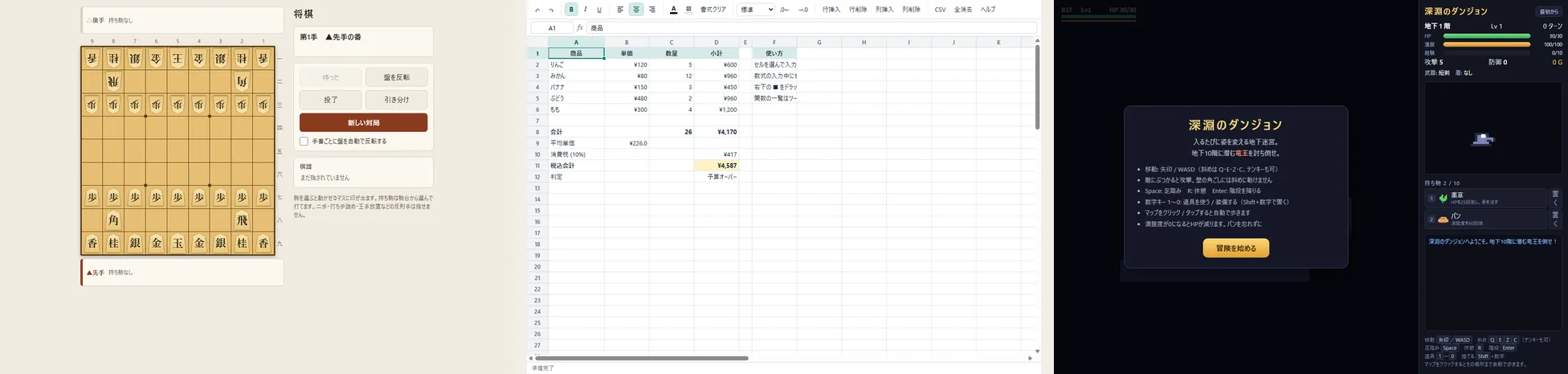
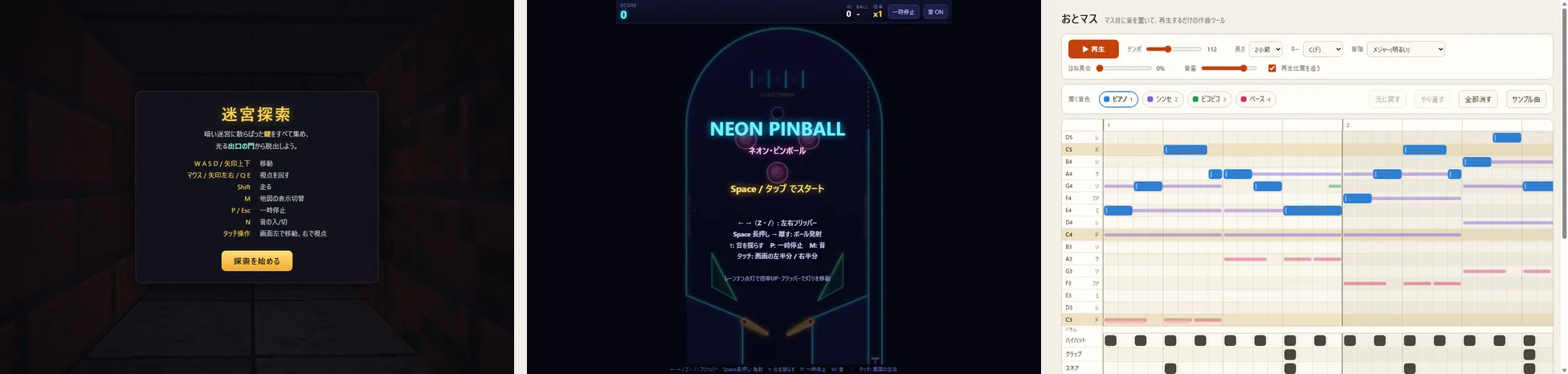
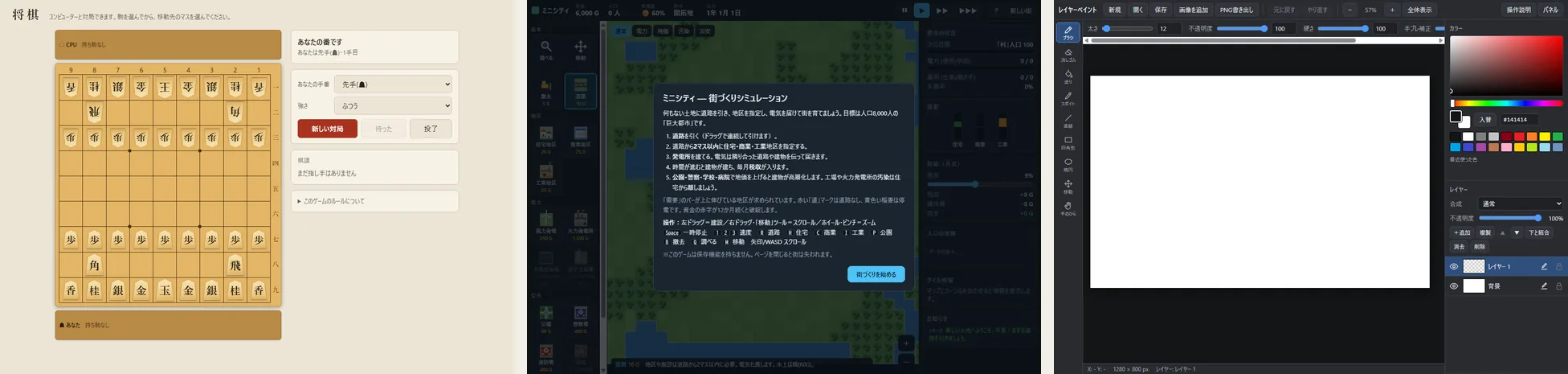

Try them yourself
Of the 25 builds (15 from the main run and 10 from the pilot), 20 can be opened on this site. What the AI wrote has not been edited. The only changes are a setting added at the top of each file to block all network access, and normalized line endings. The builds themselves are in Japanese.
- Main runMemory card game
- Main runBirthday card maker
- Main runTwo-player shogi
- Main runSpreadsheet with formulas
- Main runRoguelike with a new dungeon each run
- Main runFirst-person 3D maze
- Main runPinball
- Main runMusic grid sequencer with sound
- Main runShogi against the computer
- Main runCity-building simulation
- Main runPaint app with layers
- Main runDesktop-style environment
- PilotWhack-a-mole
- PilotMemory card game (pilot)
- PilotShooter
- PilotQuiz
- PilotColoring app
- PilotWeekly task manager
- PilotBirthday card maker (pilot)
- PilotLanding page for a fictional product
Each one runs inside a frame that cannot reach the network, so nothing you type or draw is sent anywhere. Most assume a computer, and the accuracy of the content, such as the quiz answers, has not been checked.
The other five (two falling-block puzzles, the 3D sandbox, the one-hour RPG and the RPG-style battle) are not published. Their look, mechanics or wording were judged too close to well-known existing works. A one-sentence request can lead an AI to return something modeled on a famous title. That was one more thing this experiment showed.
How deep the checks went
"Usable" means a human actually operated the build and confirmed the three checkpoints. For the checkpoints that only show up at the end, this is what was done.
- Two-player shogi: illegal moves such as a second pawn on the same file were tried and were blocked
- Shogi against the computer: one full game was played to checkmate
- Roguelike: both taking the stairs to the next floor and dying to end the run were seen
- RPG: the town, the dungeons and combat were checked, and the game was played through the boss to the ending
Many other things were not checked at all: whether the builds hold up over long use, whether the finer shogi rules such as repetition are correct, whether the games are well balanced, and whether all of the roughly 100 functions the spreadsheet is reported to have are correct. These are outside the verdict.
The ten-build pilot
The day before the main run, there was a pilot of ten staple subjects: a falling-block puzzle, whack-a-mole, a memory game, a shooter, an RPG-style battle, a quiz, a coloring app, a weekly task manager, a birthday card maker and a product landing page.
All ten opened and ran. This was the reaction after trying them (translated from Japanese).
They are all well made. Releasing them as games would still take repeated test play and difficulty tuning. Even so, it is hard to believe each one came from a single request.
The pilot is not counted in the 15 above because its conditions were different. The AI was not stopped from checking its own work before saving, and how much it did varied by subject, from writing only to running automated tests and tuning the difficulty. Checkpoints were not set in advance either.
Since staples showed no differences, the main run added "no testing" to the request to even out the conditions and raised the difficulty step by step.
Extras nobody asked for
Each request was a single sentence such as "Please build a falling-block puzzle game." What came back included many features that were never requested.
The falling-block puzzle had a next-piece preview, hold, sound effects and touch controls. Shogi had undo, a move record and repetition detection. The spreadsheet had cell formatting, row and column insertion, and CSV import and export. The desktop-style environment had eight apps, including a notepad, a calculator, a paint app and a minesweeper game.
This comes from the AI's own reports and from what was visible on screen. Whether each extra works correctly was not checked. Only the three checkpoints set in advance were.
The limit was not found
After all 15 passed, six harder subjects were drafted, including four-player mahjong with scoring, block-stacking physics and a puzzle with 50 stages that must all be solvable.
That plan was dropped. Laid side by side, it was hard to tell whether the subjects were really harder. The checking effort was also too large. A person cannot realistically confirm that all 50 stages can be solved.
Another idea was to fix one subject and only increase the number requested. That one had started to drift away from the original question.
So the experiment stopped here. It does not answer where an AI stops being able to build. What it shows is only that nothing broke within the range that was tried.
WHAT REMAINED
The checking side hit its limit first
We asked Claude Code (Claude Opus 5.5) for 15 things, one sentence each, with no testing. From a memory game to shogi that blocks illegal moves, a spreadsheet that calculates formulas, a 3D sandbox and a one-hour RPG, all 15 met the three checkpoints set in advance.
What did not go as assumed is which side reached its limit first as the difficulty rose. It was the checking side, not the building side. Building took minutes to tens of minutes. Confirming that a build is correct takes the time to play shogi to checkmate or an RPG to its ending.
One model was used, and each subject was built once. One person judged the results, checking three points per build. The same request sent again would likely return something different.
Across these 15, a one-sentence request never broke. The one who gave up first was the person checking.
EXPERIMENT DATA
Experiment data
- Dates
- Pilot: 8 October 2026 / Main run: 9 October 2026
- Environment
- Claude Code (desktop app)
- Model
- Claude Opus 5.5
claude-opus-5-5 - How builds were run
- One fresh conversation (subagent) per subject, given the request once
- Main run size
- 5 levels × 3 = 15 builds
- Verdicts
- Usable 15 / Runs but not usable 0 / Does not run 0
- Build time
- Shortest about 2 minutes / longest about 35 minutes
- File size
- About 20 KB to 91 KB each (one HTML file)
- Testing by the AI
- None. The request forbade it, and the AI reported not running the code for all 15
- Automated checks
- Done by Claude Code for all 15: a single file, no external assets, network requests or storage in the code, and no errors when opened in a browser
- Human judging
- One person, the site operator, operated each build and marked each checkpoint
- Pilot
- Ten staple subjects under different conditions. Not included in the numbers above
- Roles
- Claude Code: proposals, draft conditions, building, automated checks and the draft of this article. Human: choosing the plan, approving the conditions, judging and approving publication
- Built files
- 20 of the 25 are published. Five judged too close to existing works are not. The published files are as built, apart from the added network-blocking setting and normalized line endings
- Added cost
- 0 yen / no new subscriptions or purchases for this experiment
The request template as actually sent (Japanese)
{題材}を作ってください。HTMLファイル1つで完結させ、外部の素材・ライブラリ・通信・ブラウザの保存機能(localStorage、Cookieなど)は使わないでください。書いたコードを実行したりテストしたりせず、書き上げたものをそのまま {保存先} に保存してください。質問はせず、この1回の依頼で完成させてください。